Two next-generation formats
Both AVIF and WebP are designed to replace JPEG and PNG with better compression. AVIF (AV1 Image Format) was released in 2019 by the Alliance for Open Media. WebP was released by Google in 2010. They represent the evolution of web image compression over the past decade.
Compression comparison
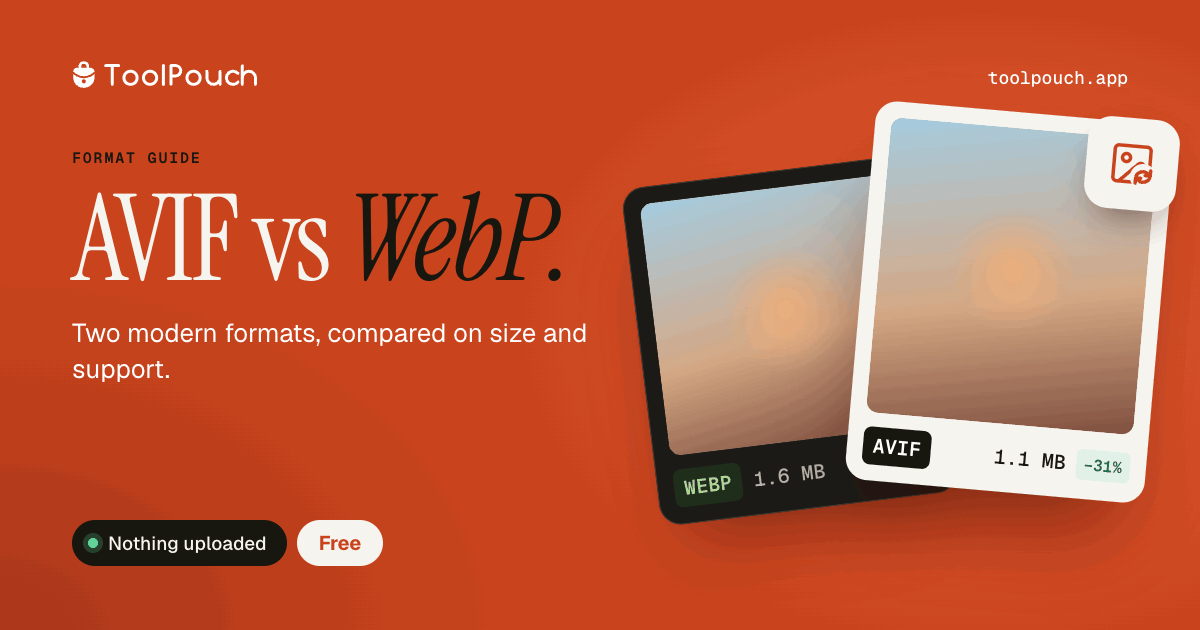
AVIF typically produces 20% smaller files than WebP at the same visual quality. Both are significantly smaller than JPEG. For a typical photograph at quality 80: JPEG might be 200KB, WebP 150KB, AVIF 120KB. The size difference multiplies across large image collections.
Browser support
WebP is supported by all major browsers with 97%+ global support. AVIF support is newer but growing: Chrome, Firefox, and Safari 16+ support it. As of 2026, AVIF has approximately 93% global browser support and continues to grow.
Encoding speed
WebP encodes faster than AVIF. AVIF encoding is computationally expensive - converting large images can be noticeably slower. For real-time or batch conversion scenarios, WebP is more practical. The speed difference is especially noticeable when processing many high-resolution images.
When to use WebP
Use WebP when you need broad compatibility. Use it when encoding speed matters for batch processing or real-time conversion. Choose WebP if your audience includes people on older browsers or devices. WebP offers an excellent balance between compression and compatibility.
When to use AVIF
Use AVIF when file size is the top priority. Use it for high-quality photography where every kilobyte matters. Choose AVIF when your audience uses modern browsers (2020+). AVIF is the future of web image compression but requires modern browser support.